20080519

On The Remainder of Time Here

I leave Ireland in ten days. I arrived home from London yesterday in the early morning, and have spent yesterday and will spend today here in Galway. Tomorrow and Wednesday I'm down in Clare, and Thursday I'm back once more, plan-less. I've considered going back over to Dublin, and I might, I haven't decided on anything yet. I could also go down to Cork, where I've not been, or somewhere in the midlands, where I've only passed through.

20080514

On Road Safety in Ireland

For those of you that have been here, well, you probably some of Ireland more back roads aren't the safest. However, there is a Road Safety Authority here. And they put out commercials such as the following , which are horrifying (but very good to have). They're especially bad during dinner, but I guess the effect is what they're going for, so they're quite successful in that sense. Not sure how well they work, though.

20080513

On Pentecost in Ireland

Pentecost, this past Sunday - incidentally also the 150th birthday of the state of Minnesota, was less than spectacular here. I went to three different services, two Catholic, one Anglican, and none were exceptionally festive. It was, as someone described to me, "just another feast day". The Anglican church was by far the most excited about the holiday, while the first Catholic service I went to - an abbey church - acknowledged it only through the readings. A bit disappointing if I might say so.

20080512

On The Lisbon Treaty

The Lisbon Treaty, the agreement signed last December (in you guessed it: Lisbon), will shortly be up for vote here in Ireland. All of the countries in the EU have to ratify it in order for it to go into effect and while all but Ireland are sending it directly to Parliament for easy ratification, Ireland, by a clause in its constitution, is having a general referendum in addition to a parliamentary vote.

For those of you not familiar with it, it's meant to replace the draft European constitution. More people than not seem in favour of the treaty, but most people I know are opposed. Not being a voter, I haven't looked much into the treaty and so don't know which way I'd vote if I could vote.

For more information you can visit yestolisbon.ie which provides general information on the treaty and well, tries to convince you to vote for it, or the bbc's article here or RTÉ's site here. A consolidated breakdown, thanks to RTÉ, can be found here.

Despite my lack of knowledge on the subject, it is a big subject - there are signs along the road every 100m urging us to "vote yes". I think they're part of
Fianna Fáil's campaign for a "Yes" vote, led by the new Taoiseach.

20080508

On Current Events

Yesterday was Brian Cowen's first day as Taoiseach here in Ireland. While nearly everyone I talked to had a good opinion of Bertie Ahern, pretty much no one has anything to say about Brian Cowen except how boring he is and how much less personable than Bertie Ahern. A grand start I'd say! Everyone was hoping Mary Harney, the minister for health and children (and described as "a joke"), would be replaced, but she was one of the ministers that wasn't.

In other news, the Journal of Evolutionary Biology just published an interesting article on flowers and their tendencies to "wave" in the wind and how it relates to pollination (to read the BBC article click here). And! Nature just published an article on the genome of the platypus.

20080505

On Exams Once Again

I have now completed three of my four exams; I had exams Monday, Tuesday and Friday mornings. My last exam is the 12th of May. All of them are again at the racecourse (lucky me, that's 3euro each time for the bus out there, adding up to a neat 12euro or just over $18!). For my last exam there weren't enough seats on the second floor so I got bumped to the first floor with a couple other people. Everyone else on floor one was in engineering and so was male (so it made me think of Lena and her classes). And I didn't get to see how long the exam took everyone, which is how I gauge how I'm doing relative to others.

The weather lately has been amazing; it is undeniably summer and very reminiscent of mid June in Minnesota around the time of my birthday. Guess I'll get two Junes this year!

Finally, happy bank holiday to all!

20080503

On More Commercials

And on the topic of good commercials, here's another everyone enjoys (we love watching commercials):

On the Guinness Commercial Everyone Loves

We've yet to meet anyone that doesn't like this commercial:

On May in Galway

May 1st, I was told repeatedly the other day, is the first day of summer. It really is summer, too. Today perhaps isn't the best example of a day as, surprise surprise, it's cloudy and gray, but the vast majority of days of late have been warm, sunny, and insect filled. Exams are finishing up - first arts have been done over a week. I have three of my four exams finished with now, and were it a sunny dry day would be down by the bay. As of today we have 15 hours and 12 minutes of daylight; when I left the library last week after ten it was lighter out than when I used to walk home from lab at 5. I no longer get soaked every time I walk to and from college, and when I walk in to catch the bus to exams at 7 it's actually light out now (much preferable to the dark, cold, wet walks made in December). The average May temperature is just over 10C and the average wind speed is down to a mere 7m/s. Additionally, only 18 of our days are "wet", and we only get about 70mm of rain. It really is summer.

20080417

On The Geologic History of Ireland

My internet at home has been terrible at best; nearly every time I’ve been home it’s been out. The few times it’s been up, it’s been so slow I can’t even access email. So it’s been hard to make many posts. This afternoon I have my first exam, worth 25% of the final (or 15% of the overall grade). It’s in Sediments, and, inspired by my studying and by the material, I’ve decided to do a brief entry on the geologic history of Ireland. I now know the geologic histories in depth of both Ireland and Wisconsin! The history of Ireland, in my mind, is slightly more exciting than the history of Wisconsin. It helps that it’s not part of a craton though.

In the Precambrian, what is now Ireland was located in Pangaea, though the northern half of the country was separate from the southern half. In the Cambrian, when Pangaea began to break up, the Iapetus Ocean (the precursor to the Atlantic, hence the name) opened. The north lay to one side on Laurentia, the south to the other on Avalonia. During the Ordovician, Ireland was subject to explosive volcanism and significant erosion from huge deltas from mountain-source rivers. The Iapetus Ocean began to close, resulting in the Caledonian orogeny of the Silurian. During the Silurian the land was covered in mountains similar to today’s Himalayas – the range stretched from the southern United States, through Ireland, and finished up in Northern Scandinavia. The collision ended in the Devonian, when the climate became hot and arid. Ireland at that time was covered by expansive deserts with calcrete forming just below its surface.

In the Carboniferous Ireland experienced a range of activity. Giant delta systems once again eroded the land – which by now was flat and almost at sea level (fast uplifting à fast erosion), and there were a series of marine transgressions. The land was covered by swampy rainforests, and significant formations of limestone occurred during the closure of the Tethys Ocean. Today cyclothems can be found in the rock record from that time, either the result of the delta systems or of the glaciation of Gondwana in the south. In the Permian, the continents once again merged to form a supercontinent, and Ireland’s climate returned to that of a desert. Extreme chemical weathering occurred, and numerous evaporates such as gypsum and magnesium limestone were deposited.

Marine transgressions began again in the Triassic, adding to the evaporate deposits. During the Jurassic Pangaea began to break apart, and the marine transgressions continued. Mudstones were deposited in Ireland, and while not dinosaur skeletons have been (or likely will be) found on Ireland, the remains of Ichthyosaurs (!!) have been discovered. The marine transgressions continued into the Cretaceous, when Ireland was mostly covered by a warm, shallow sea. White chalk formed, today seen in only a few locations in Northern Ireland. The same white chalk deposits extended down through Britain, best seen in the white cliffs of Dover. Flint nodules formed in the chalk from sponge spicules, later drawing humans to those areas. In the Tertiary Ireland underwent further extreme changes; in the north volcanic eruptions created the Antrim basalts (including Giant’s Causeway) as the Atlantic began to open. The land was once again underwent an orogeny – the Alpine orogeny. A few rare sedimentary deposits formed beneath Lough Neagh in the north.

In the Quaternary, when South America separated from Antarctica, the world was thrown into a glaciation. By 1.8Ma the earth was fully cooled, and Ireland was covered by glaciers, completely changing the topography once again and almost entirely erasing the landforms of the Tertiary. Following the glaciation, Ireland was connected by a low-lying swampy land bridge to Britain for several thousand years, allowing the re-colonisation of the land. Humans arrived several thousand years after the closure of the land bridge; while they first arrived in Britain some 65,000 years ago, none came to Ireland until about 9,000 years ago.

And that is Ireland’s basic geologic history. Let’s see if I can remember all of it.

20080408

On The Carnage of Spring

Due to my rare internet connection, I have been unable to update in some time. However, now that it's summer, I've much more to do as it's beginning to be nicer outside than not. I read, on some tourist site, that it's "summer" hours ran from April til September. Thus it is summer. I thought it a lovely concept and am willing to run with it. While perhaps it may not actually be summer, it definitely is fully into spring. Even the snails have emerged, their bodies now painting the sidewalk into a slick surface broken only by their shell remnants. Natural selection at work, operating to create a harder shell.

20080401

On April in Galway

In April, we apparently get nearly 5(!!) hours of "sun" per day, up from about 3.2 in March. The average high is 12, and the low 5C. The average rainfall is half that of March - all the way down to 52mm. The average wind speed is 8.4 knots, the lowest average over the entire year. And according to some tourist websites, summer hours are in effect April-September. So apparently it's summer, and this is possibly the nicest it'll get. I'm hopeful.

20080331

On March in Galway

Usually I do the average weather information at the beginning of the month, but this month I'm doing it at the end. Next month's will hopefully be tomorrow - making comparison quite easy! The general weather trend in Galway is generally cyclical (like everywhere) with December and January being the absolute worst (an hour of "sun" a day and a relative humidity approaching 90 with between 100 and 125mm of rain). March has been considerably nicer. The average high in March is just below 10 with the low around 3C. The wind speed averages to 10.6knots, and rainfall is all the way down to around 100mm. On top of that, we get an incredible 3.2 hours of "sun" per day! Which is pretty much amazing. But just wait to find out about April - apparently it CAN get better!

20080330

On St.Patrick's Day in Ireland


So I know it's been a while, but I've been gone. Easter break has been the past two weeks, allowing me a fair bit of traveling. I began my break with a visit from Lena (down from Sweden). We spent the majority of St.Patrick's Day in Dublin. Due to its proximity to Easter and Holy Week the holiday itself was moved and its status as a day of obligation was removed for the year. I wasn't in church for the moved date, and I don't think a whole lot of other people were, either. While its date was moved, it was still celebrated on the 17th - though celebrations began the previous Friday. It was quite similar to celebrations in the US, but in a way also similar to the 4th of July in the US. Green and orange were everywhere, various "Irish" costumes were worn, and everyone celebrated. Lena and I went to the parade (where she proved to me that to be small is definitely a disadvantage) and spent the morning about the city. In true Ireland fashion (not being insulting, it's just what I've found to be the case more often than at home) the parade started late. Half an hour late. The weather was absolutely gorgeous though, so it wasn't at all unpleasant to be out in. I'm completely convinced that side of the island is always sunny. It always is when I visit. Below I've included an RTÉ clip (from YouTube) of the parade:

On Connaught

While in Kilkenny about a month ago now, I stopped in at one of the small museums in town. My favorite exhibit was on Irish recent history, particularly the section involving Oliver Cromwell. What made it my favorite? A nice little board off to one side reading:

"...Cromwell tried once and for all to crush the Irish resistance by deporting thousands of Irishmen, using the catchphrase:
" 'To Hell or to Connaught!'
"At the sight of the poor and barren province of Connaught located to the west of Ireland, one of Cromwell's own generals observed that there was 'neither water enough to drown a man, nor tree to hang him, nor soil enough to bury him.' "

It made me smile. It's really not that bad though, and can be quite scenic.

20080309

On Winter in Ireland and Photography

Yet another post, this time on visual art. RTÉ had a photography competition on "wintery scenes" (of Ireland). The winners and runners up etc. can be viewed at RTÉ's website. They're all fairly similar stylistically, but quite nice and very much natural Ireland.

On Music and Poetry

Continuing with the trend of including flash clips from YouTube, I've included a couple more here relating to Irish music. We've just begun covering the role of music in Irish culture in my Irish culture course here at NUIG, and it's by far my favorite part. Finally a topic worthwhile! (No offense to poetry but to me it is a waste of time and honestly, if it was important poets would just come out and say it instead of hiding it in allegories requiring hours of thought and interpretation). Then again I've no patience for poetry. Music I absolutely love though. The current musician we're covering is Sean O'Riada who composed the score to Mise Eire. For a bit of commentary (provided by BBC 4 via what else, YouTube):


For a beautiful singing of the song Róisín Dubh (from which O'Riada got his theme for his main composition of the piece) you can hear Caitlín Maude. You have to wait a moment to hear the vocals. The lyrics, provided, are as follows with the translation (this is one of many versions):

A Róisín, ná bíodh brón ort ná cás anois

Róisín, do not be sad or distressed now

Tá do phardún Ón bPapa is ón Róimh agat

You have your pardon from the Pope and Rome

Ta na bráithre ag teacht thar sáile 's iad ag triall thar muir,

The priests are travelling over the seas

Is ní cheilfear fíon Spáinneach ar mo Róisín Dubh

And Spanish wine will comfort my Róisín Dubh

Tá grá agam i mo lár duit le blain anois,

I have a lonely love for you for a year now

Grá ceilte, grá cásmhar, grá ciapaithe

Love hidden, love plaintive, love tormented

Grá a d’fhág mé gan sláinte, gan rian, gan rith

Love that has left me without health, without vigour, without energy

Is go brách, brách, gan aon fháil agam ar mo Róisín Dubh

And forever and ever, looking for my Róisín Dubh


Beidh an fharraige ina tuillte deagra is an spéir ina fuil.

The sea will flood with red and the sky will be blood

Beidh an saol so ina chogadh craorach de dhroim na gcnoc.

This world will be at war crimson war from the hilltops

Beidh gach gleann sléibhe ar fud na hÉireann is móinte ar crith

Every mountainy glen and bog throughout Ireland will shake

Lá éigin, sara n-éagfaidh mo Róisín Dubh.

Should me Róisín Dub die some day.


So I guess I do like poetry. Though I still say the vast majority wasn't even worth the time it took for the poet to write it.

On Dublin and Tourism


Most people I talk to here don't care overly much for Dublin; I don't either, but it's still a fun weekend and the commercial sure is cute.

20080305

On Dustin the Turkey

For those of you that haven't heard, Dustin the Turkey will be representing Ireland at this year's Eurovision competition. If you're interested, here he is:

20080223

On Products, Buying

A lot of things here are the same as in Britain. As in most. I think it's weird since I always imagined different countries had different stores, brands, etc. Some things of course (more all the time) are global, but really, I'm surprised even the little stores here are the same. It's like Minnesota and Wisconsin only it's Ireland and Britain. This commercial always makes me think of Lena:


I finally tried one, too. Not bad, though everyone here eats the Kinder ones instead (which I have yet to try).


I think perhaps at the time the ad came out it wasn't so weird? Dunno it was before my time.

20080219

On Getting Sick And Its Benefits

The good thing about getting sick, and why everyone (including me) should welcome the opportunity, is that it really is true that what doesn't kill you only makes you stronger. In order to display genetic fitness, a strong immune system is of key importance. And the way to get a strong immune system is to be exposed to germs and viruses that you will overcome. So every time an illness comes your way, you really ought to appreciate the opportunity to become slightly superior to another individual and thus begin to out-compete that individual.

On Where I've Been, Where I've To Go

Here's my checklist of counties I've been to in Ireland and Northern Ireland. I've a ways to go... though I've got Connaught done! Then again, it'd be embarrassing if I didn't as I do, after all, live in Co Galway.


Ulster:
(_) Antrim
(_) Armagh
(_) Cavan
(_) Derry
(X) Donegal
(_) Down
(_) Fermanagh
(_) Monaghan
(_) Tyrone

Leinster:
(_) Carlow
(X) Dublin
(X) Kildare
(_) Kilkenny
(_) Laois
(_) Longford
(_) Louth
(X) Meath
(X) Offaly
(X) Westmeath
(_) Wexford
(X) Wicklow

Munster:
(X) Clare
(_) Cork
(X) Kerry
(X) Limerick
(_) Tipperary
(_) Waterford

Connaght:
(X) Galway
(X) Leitrim
(X) Mayo
(X) Roscommon
(X) Sligo

On The Changes of February

February, it seems, is astoundingly different from December and January. Or perhaps it's just this year. However, we've not had rain in nearly a week and a half, we had a week in which it was quite (relatively) sunny, and the wind is slow and without ill intent. We've had quite a bit of fog; one day it rolled in off the bay so fast that within five minutes it went from being gorgeously sunny to completely enshrouded in fog so that you'd not see 30m in front of you. And we're not even very close to the bay.

20080211

On Dublin and My Weekend

Those of you that know French, if I made a mistake let me know since I kept trying to turn it into Spanish (as did my computer which automatically switches to Spanish if it figures out it's not English). It was my favorite part of my church crawl in Dublin.

Seigneur, je vous en prie,
que la force brûlante et douce
de votre amour
absorbe mon âme et la retire
de tout ce qui est sous le ciel,
afin que je meure
par amour de votre amour,
puisque vous avez daigné mourir
par amour de mon amour.

20080208

On Bacteria and Prescriptions

Today, after making it through the past several days with no improvement whatsoever in my mouth (it got significantly worse, in fact), I decided to go in to the clinic again. I went in, got an appointment for later in the morning, and was allowed in much more quickly than on Tuesday. The nurse remembered me, and when she checked my mouth she went "oh, wow. You should get an appointment with one of the doctors today, you definitely need a prescription". So I got an appointment. The wait wasn't too long, and I was in fairly quickly. The doctor looked at it, called me "poor thing" multiple times, and gave me a prescription for an antibiotic and steroid. Turns out it was an anaerobic bacteria (oh joy) that found my mouth very hospitable (evident by it's thriving state and rapid colonization). Now I'm on medications, though, and should be better by Monday! If not, well, I'm to go back in. But I'm thinking it should be better.

And now? I'm off to Dublin.

20080206

On Ash Wednesday Here

I decided to attend the 13:10 mass today at the campus chapel. It was a nice service, but we had to administer the ashes amongst ourselves. I, almost inevitably it seemed, failed in my administration because unlike the usual ashy texture I was expecting, it was paste. And since I had been expecting ashes, I'd only dipped my finger in a little, resulting in insufficient ash content to properly draw a cross, and my having to re-dip mid way to complete the cross. Additionally, one of the readings was a paraphrased version, updated to be, I suppose, more modern. I wasn't a fan, but I suppose it reached a certain audience and perhaps was more accessible. I actually quite like the chapel; the Anglican church in town has a very small congregation in a very large setting, and the Catholic cathedral is a bit intimidating and huge. The chapel, granted, isn't as architecturally interesting as either of the other two, but it's closer, more convenient, and the people are more approachable and friendly. So it's my favorite for now.

On Today's Efforts

Today I bought three new toothbrushes; one for my special paste, one for my regular paste, and one for when I'm well again. I threw out my old one, and am cleaning my other mouth things in boiling water regularly. I will further buy a new waterbottle tomorrow. I've now been taking the medicine for over 24hrs, and it's only gotten worse, but I'm going with the idea that it merely needs a while to become effective. It now is extremely painful, pretty much making it impossible for me to do readings and such (too distracting), and I'm on the it's-too-painful-to-eat-so-I'm-not diet. In addition to general pain and swelling and discolouration.. it is now peeling off. Which is all very lovely. My hope is that I wake up tomorrow and it's considerably better. If it's not improved by next Tuesday (a week from my doctor appointment) I'll definitely be back in.

20080205

On Mouth Ailments

So my mouth has been bothering me for a couple days now, and this morning, since it hurt so bad and looked so gross, I decided to go in to the college nurse and ask about it. I was given an appointment for 20 past 11, was there on time, waited half an hour before being seen, and then spent about 5 minutes in the office. Her verdict: I either have a) a fungal infection, b) a bacterial infection, or c) gingivitis. As you can imagine, I was thrilled. I was sent (through the pouring rain, mind you) to the university pharmacy where I picked up a cream that I'm now to use three times daily (2cm applied and brushed for 1-2min each time) for a month. She didn't seem overly concerned so I'm thinking it's not terrible, though I'm too afraid to look into it. Better not to know and simply get better I'd say. In the mean time I've to put up with the general acheyness in my teeth and gums, and for an unspecified time period. I'm hoping it's short.

20080201

On February in Ireland

Galway (53°16'48"N, 9°03'36"W) averages 75mm of rain in February - down over 30mm from January. From what I've seen so far, it's not much sunnier than the past several months, however. An interesting article from Reuters on the sunniest places can be found here, with an interesting map linked here. Notice Ireland on the map. The highlight of the day, though, was that it snowed. On Wednesday it rained, on Thursday it hailed, and on Friday it snowed.

20080131

On Music, Etc.


20080129

On Ireland's Forests

Two million years ago just prior to the glaciation which enveloped Ireland, the island was covered in soils up to 30m thick in some areas, and the climate was warm and tropical. After the glaciation the landscape was changed drastically, looking very similar to the rocky terrain seen today. Between 10,000 and 8,000 years ago the land bridges connecting Ireland to Britain and to continental Europe were covered by the sea, and between 9,000 and 10,000 years ago the first humans settled in Ireland. At that time the landscape was covered with many small lake (still present today), but with much less turf bog. Instead, great forests of oak, elm, ash, birch, and pine covered the lowlands. Between 6,000 to 5,000 years ago the population was replaced by a new people migrating from the mainland. These people, unlike their predecessors, were agriculturalists. By that time the forests were in a slight decline – the soils were poor and the bogs were growing so conditions were not favorable – and with the new arrival their decline accelerated.

In the 1200s deforestation accelerated the decline further. It was at that time that the English, in their attempts to conquer Ireland, began attacking the woods. It was commonly believed that “the Irish could not be tamed while the leaves were on the trees,” so King Edward I declared in a statute given in 1296 that:
“The Irish enemy, by the density of the woods, and the depths of the adjacent morasses, assume a confident boldness; the king’s highways are in places so overgrown with wood, and so thick and difficult, that even a foot passenger can hardly pass. Upon which it is ordained that every lord of a wood, with his tenants, through which the highway was anciently, shall clear a passage where the way ought to be, and remove all standing timber, as well as understood.”
The English eventually had to retreat after the Gaelic Revival and black plague epidemic, and the forests were left relatively alone until the 1600s.

In the 1600s the demand for wood in England greatly exceeded the supply. Businessmen, with the support of Elizabeth I, turned to Ireland to secure greater resources. While Elizabeth I supported the exploitation of the Irish forests for fulfilling England’s demand, she also ordered their destruction in order to deny the Irish of the shelter they provided. While forestry conservation practices were beginning to form in England, they were not brought to Ireland, and the forests were all but gone by the mid 1600s.

On the Euro
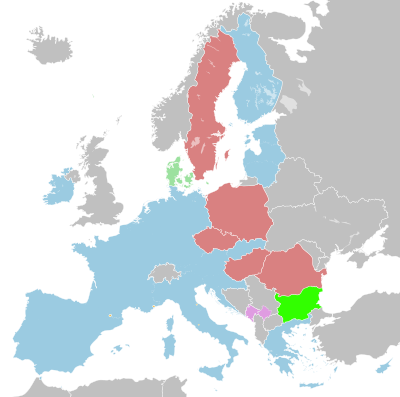
The Euro is used in the countries in blue. It's quite the handy system, and in the Czech Republic a competition is currently underway for designing their faces. Here I've included most of the one euro coins - some currently in use and some designed for future use. I'm not sure why the images turned out in the design they did, they just.. did. Here in Galway we mainly come across coins from Ireland (naturally), France, and Germany. There are some from Spain, and even fewer from everywhere else.




20080128

On Mitt Romney


Today we have a second candidate: Mitt Romney. While he's also not my choice (I should stop admitting these things, though I suppose most of you know anyhow who I'm supporting) here is some basic information (also from CNN) on him:

- He opposes abortion rights except in cases of rape, incest, and protecting the mother’s life

- He opposes guest worker plan, opposes allowing illegal immigrants to gain legal status besides ways already in place, supports use of police for enforcement

- He supports banning assault weapons and thinks current background check are adequate

- He supports “covering the uninsured without raising taxes or creating a government-controlled system” (CNN)

- He opposes federal funding for embryonic stem cell research and opposes creating new embryos for research

- He opposes troops withdrawal, supports sending additional troops

- He opposes both same-sex marriage and civil unions

- He supports private firms providing for retirement

- He supports tax cuts and wants to make Bush’s cuts permanent

For more information, go to his campaign site: http://www.mittromney.com/

On Ireland and Housing

Here's a clip from a story the BBC had that talks about Ireland and housing (the article was on making homes that produce no greenhouse gases):

Few European countries have seen such rapid economic growth in recent times as Ireland, where the "Celtic tiger" phenomenon stimulated the house-building industry, with demand and prices quickly rising.
Joe Durkan from the House of Tomorrow Programme, a project of the government agency Sustainable Energy Ireland, believes the introduction of energy performance certificates in this thriving house-building sector has raised the profile of energy efficiency.
"There's lots of information about it, and lots of excitement," he told BBC News.
"Builders are now using it as a marketing tool; the certificates have a sliding scale from A to G, and developers are now competing to offer A1 certificates on the properties they have for sale."

20080127

On Hillary


Hillary has a lot of support, so I'll start with her. As I'm registered to vote in Wisconsin but have no current address in Wisconsin I've had to reapply to vote in Minnesota, and as I'm living in Ireland not Minnesota, I needed an absentee ballot. I tried to register, but sadly it was too late and I'll not be voting in the primaries. So here's some information for those of you that will be voting. Hillary's not my choice, but I'll be beginning with her anyhow. Following is some basic information I got from CNN:
-She supports abortion rights
-She supported Bush's immigration reform legislation
-She wants extensive gun background checks and regulation
-She supports individual health insurance coverage for all Americans
-She supports expanding stem cell research
-She originally supported use of force in Iraq but now wants troops withdrawn and a cap put on the number of American troops in Iraq
-She
supports civil unions, wants it to be up to states to decide on laws
-She opposes Bush's ideas on social security changes, and
-She is opposed to extending tax cuts

For information provided by her and her campaigners (so not biased at all) you can go to her webpage at http://www.hillaryclinton.com/

20080123

On Utricularia


Utricularia species are aquatic plants native to Ireland that live in bogs and Nitrogen-poor areas. Most plants subject to Nitrogen poor conditions experience poor photosynthesizing processes; Nitrogen is key in the synthesis of proteins and nucleotides, and so plants with Nitrogen deficiencies begin bleaching and eventually die from being unable to photosynthesize. There are plenty of plants that have developed the ability to fix nitrogen themselves - but Utricularia spp. opted for the carnivorous path.

Utricularia have fine leaves and small ~3mm long "bladders". On one side, the bladders have an aperture from which stiff bristles extend in a funnel-like shape. The aperture has a hinged valve which can open inward, and when small insects (worms, larvae) or zooplankton swim by and brush the bristles the valve opens creating a change in pressure and sucking the surrounding water and animals into the bladder. There is no escape for the animals, and they decompose and are digested - providing the plant with its much needed Nitrogen.

On Plasmodesmata, A Highly Interesting Science Topic

So I'm in hydrology - which, by the way, is starting out extremely slowly (we all know what the water cycle is.. we all know what a catchment is..) - when the professor asks the class "someone, give me a science topic, any topic. It should be something you're interested in or doing research on." Naturally no one says anything. So he goes "how about the girl in the front?" (I was sitting in the front because it's a flat classroom and if I sit several rows back like last time I can't see over tall peoples' heads). So I just stare at him. Then, I blurt out the only thing I can think of off hand that I'm significantly interested in - plasmodesmata. And he, being a hydrologist in a geography department, just kind of looks at me. So I have to repeat it. And it's one of those words that is spoken slightly differently here, so I was trying really hard to pronounce it the Irish way, making the repetition quite painful. And again he just looks at me. Then he goes "what..?" and I have to explain and finally he decides "okay, we'll look up 'plants' and 'cell walls' ". Highly embarrassing I tell you. And having read this if you aren't familiar with plasmodesmata, you should look them up. They're really cool.

20080120

On Today and Other Things

So the most exciting thing that happened today? Lena and I are now going to Oslo! We'll be there mid-February, and will I'm sure have a fantastic time!

And the second most exciting thing that happened today? I started the 2006 season of Doctor Who! And tomorrow Lena and I will already be on to the third episode - it's a treat for after our long Mondays, though hers is worse than mine.

My classes are, for those of you that don't know, Plants and the Environment, Hydrology, Sediments and the Biosphere, and Imagining Modern Ireland. All of my schedule concerns worked out, and classes have begun well. Tomorrow I have botany, botany lab, and Sediments.

20080118

On Top Irish Names

The top ten names given to babies in Ireland in 2006, the latest figures I could find, were:

Boys:
1. Sean
2. Jack
3. Conor
4. Adam
5. James

Girls:
1. Sarah
2. Emma
3. Katie
4. Aoife
5. Sophie

20080111

On Beautiful Days

The past two days have been incredibly beautiful days, especially for winter in Ireland. I walked down along the coast for a couple hours today, and a couple hours yesterday. With any luck the weather will be as nice tomorrow and the walk can be repeated.
None of the Irish students have begun arriving back for the resuming of courses - which occurs Monday - and I'm guessing it won't be until Sunday night that they begin coming in. In the mean time it's just the American and Erasmus students. With so few people the internet connection is fantastic, and I can download and upload and load in general well.
And now for one of my favorite types of photographs - the interesting ones! One of my favorite places in Galway is the beach at low tide, when you can see all of the water-tracks. They're fascinating AND fun to play with (it's so much fun damming up the ones that still have water in them). It's also fun to play the identification game - basically where you go around and identify the different kelps washed up, or in some cases still living but exposed due to the low tide.
I have finally developed a tentative schedule of classes - I have decided to take Plants and the Environment, Sediments and the Biosphere, Imagining modern Ireland: An Introduction to Irish culture studies, and either hydrology or Intro to GIS. I think I might enjoy all of my classes this semester!

20080110

On Classes and Requirements

So it’s that time of the year again; the time for choosing courses and attempting to fulfill requirements. So far, I have completed the following:

CORE REQUIRED CLASSES:
X Bio 151
__ Bio 152
__ Chem 103
X Geol 100
X AOS 105

ECOLOGY AND EVOLUTION:
X Geol 110
__ Zoo 360

SPECIES AND FIELD BIOLOGY:
X Bot 330
__ Anything on the list

OTHER ELECTIVES:
X AOS 100
X Bot 260
X Econ 101
X Geog 339

COURSES I SHOULD BUT DON’T HAVE TO TAKE:
__ Wetland Ecology (“other elective” category)
__ Soil Science (“other elective” category)
__ Intro to computer programming (other elective” category)
__ Intro to GIS (other elective” category)
__ Plant Systematics (Species and Field Biology)

Of the courses I can take next year, one may – if I persuade the department – contribute toward the Species and Field Biology list. Another may – again I’d have to talk to the department – contribute toward the “other electives” category (which I’ve finished so it would be unnecessary). And I haven’t a clue as to how I will top off my schedule as I haven’t come to a decision on taking both botany classes. It pretty much, at this point, comes down to what I decide the main purpose of this semester to be – will it be an educational opportunity school-wise, or travel and culture-wise? If I take the two botany courses and the sediments and the biosphere course, my schedule will be the following:

Monday

Tuesday

Wednesday

Thursday

Friday

10-11 BOT217
10-11 BOT317
13-14 EOS
14-16 BOT217

10-11 BOT217
11-12 BOT317


9-10 BOT317

9-10 BOT217
12-13 EOS212
14-18 EOS212
14-18 BOT317

(uh oh another clash.. and an unavoidable one..)

12-13 BOT 317
13-14 EOS212

So I guess I can do BOT217 and EOS212 together, or BOT317 and EOS214 together, but no switches. So perhaps I will do BOT217 and EOS212. Or BOT317 and EOS214. Both Botany courses I think I can get to be “species and field biology” courses, and both EOS classes might possibly be “other electives” so either option is acceptable.

20080109

On The Predator Satiation Hypothesis

The predator satiation hypothesis says that the synchronous production of fruits (or nuts, etc.) maximises the probability of satiating local predators, thus allowing a greater number to escape predation and survive to germinate. Just so ya know.

On Courses for This Semester

Courses at NUIG resume next Monday the 14th. Currently, I am debating enrolling in Botany 217: Plants and the Environment, Botany 317: Aquatic Plant Science II, Earth and Ocean Sciences 212: Sediments and Biosphere I, and Earth and Ocean Sciences 214: Materials of the Lithosphere. I would take only one of the two EOS courses, but at this point I have not reached a decision as to which. One minor (well, major, actually) flaw in my ideal schedule is the small fact that Bot 217 and Bot 317 overlap. Well, only one lecture each week overlaps. But a vast majority of students here seem to miss their lectures right and left - so is it something that should hold me back? I spoke with one of the professors (who also lectured for Bot 216 which I took this semester) involved in both classes, and she told me that based on my work for 216 she thought I would do "fine" taking both. But what does "fine" mean - will it mean "good enough" or only "acceptable"? And can "good enough" be only "acceptable"? Madison doesn't really offer good marine plant (or marine in general) classes, and aren't I here to take classes and learn things I wouldn't at Madison? Since we don't need to register for classes for several weeks I'm planning on attending both at the beginning, talking to the professors, and seeing how it goes.

Interestingly enough, EOS 212 and 214 do not overlap either with each other or with either Botany course. I refuse to take both simply because I can though. Basically, I'm figuring out which I will not enjoy slightly less to determine which I will take this semester. EOS 214 provides an introduction to crystals, minerals, and rock. EOS 212 provides an introduction to sedimentology and palaeontology. I'm thinking EOS 212 at this point.

20080107

On John Muir

When I was in Scotland on my bustour of the highlands, towards the end, the driver began quizzing us on various famous Scots ("who is __?"). One of the people he asked if we'd heard of was John Muir! This was toward the end, and no one had really been answering, so he didn't give us a chance to respond as he moved on (given up, I suppose). He proceeded to admit to us that he didn't expect that we had heard of him (much to my horror!).

And now, for those of you who weren't sure where I got my blog title from, here is a quote from one of my favorites:
"When we contemplate the whole globe as one great dewdrop, striped and dotted with continents and islands, flying through space with the other stars, all singing and shining together as one, the whole universe appears as an infinite storm of beauty."
John Muir The Story of My Boyhood and Youth (1913)

On Haircuts in Ireland


There comes a time when a haircut becomes necessary. So today, after nearly five (yes I know, it's terrible) months, I had my first haircut here in Ireland. For the price ($50 USD) it was a rip-off. But everything here is expensive, and while I'm sure I could have found a cheaper place, it's location and quality may have been questionable. So I settled on the close and easy place. I did, thankfully, qualify for the student discount (20% off), but it still cost 32. The haircut did what was necessary; I am now free of my gross split ends, and it falls more sleekly and with better style. The process took approximately 30 minutes (that's about €1 per minute, folks), and I couldn't help but notice she spent as much time drying and brushing it as she had cutting it. Never a good thing. I got a wash out of it that I hadn't been expecting (apparently a "dry haircut" involves a full washing?), and was offered tea or coffee (both of which I rejected out of the fear that they would add additional fees to my total cost). Overall, I was quite unimpressed. My haircut in August was superior in every way.

20080106

On Galway


View Larger Map

On January In Ireland

In January in Ireland, there are an average of just over 22 days of precipitation. There are around 107mm of rainfall during the month, and the average temperature is 5C. The average wind speed is just over 10 m/s. On nights such as tonight, it can be much stronger, gusting so hard it comes in the cracks in the windows and back down through the ventilation fans. In the daytime, it's not so bad.

20080105

On Random but Interesting Facts

After nearly three weeks of travel, I am back in Galway. My travels went well, though it is nice to get a break. And now I have some interesting and slightly random facts on Ireland. Ireland is a relatively small country, just under about 70,000 sq km. However, their size about doubles when you take into consideration that countries include all of the continental shelf surrounding them. There are some disputes with surrounding countries as to where continental shelf boundaries begin and end (notably with the UK and Norway). As of 2007, less than 17% of the land was arable, and less than 1% covered by permanent crops. The population is around 4.2 million, and around 40% live in the Dublin area. And while the country is about the size of West Virginia, there are 34 airports. Per capita GDP is the second highest in the EU behind Luxembourg.