20080131

20080129
On Ireland's Forests
Two million years ago just prior to the glaciation which enveloped Ireland, the island was covered in soils up to 30m thick in some areas, and the climate was warm and tropical. After the glaciation the landscape was changed drastically, looking very similar to the rocky terrain seen today. Between 10,000 and 8,000 years ago the land bridges connecting Ireland to Britain and to continental Europe were covered by the sea, and between 9,000 and 10,000 years ago the first humans settled in Ireland. At that time the landscape was covered with many small lake (still present today), but with much less turf bog. Instead, great forests of oak, elm, ash, birch, and pine covered the lowlands. Between 6,000 to 5,000 years ago the population was replaced by a new people migrating from the mainland. These people, unlike their predecessors, were agriculturalists. By that time the forests were in a slight decline – the soils were poor and the bogs were growing so conditions were not favorable – and with the new arrival their decline accelerated.
In the 1200s deforestation accelerated the decline further. It was at that time that the English, in their attempts to conquer Ireland, began attacking the woods. It was commonly believed that “the Irish could not be tamed while the leaves were on the trees,” so King Edward I declared in a statute given in 1296 that:
In the 1600s the demand for wood in England greatly exceeded the supply. Businessmen, with the support of Elizabeth I, turned to Ireland to secure greater resources. While Elizabeth I supported the exploitation of the Irish forests for fulfilling England’s demand, she also ordered their destruction in order to deny the Irish of the shelter they provided. While forestry conservation practices were beginning to form in England, they were not brought to Ireland, and the forests were all but gone by the mid 1600s.
In the 1200s deforestation accelerated the decline further. It was at that time that the English, in their attempts to conquer Ireland, began attacking the woods. It was commonly believed that “the Irish could not be tamed while the leaves were on the trees,” so King Edward I declared in a statute given in 1296 that:
“The Irish enemy, by the density of the woods, and the depths of the adjacent morasses, assume a confident boldness; the king’s highways are in places so overgrown with wood, and so thick and difficult, that even a foot passenger can hardly pass. Upon which it is ordained that every lord of a wood, with his tenants, through which the highway was anciently, shall clear a passage where the way ought to be, and remove all standing timber, as well as understood.”The English eventually had to retreat after the Gaelic Revival and black plague epidemic, and the forests were left relatively alone until the 1600s.
In the 1600s the demand for wood in England greatly exceeded the supply. Businessmen, with the support of Elizabeth I, turned to Ireland to secure greater resources. While Elizabeth I supported the exploitation of the Irish forests for fulfilling England’s demand, she also ordered their destruction in order to deny the Irish of the shelter they provided. While forestry conservation practices were beginning to form in England, they were not brought to Ireland, and the forests were all but gone by the mid 1600s.
On the Euro
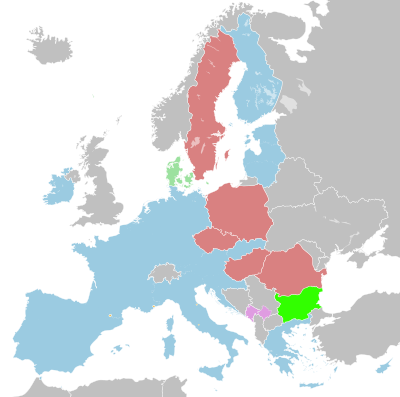 The Euro is used in the countries in blue. It's quite the handy system, and in the Czech Republic a competition is currently underway for designing their faces. Here I've included most of the one euro coins - some currently in use and some designed for future use. I'm not sure why the images turned out in the design they did, they just.. did. Here in Galway we mainly come across coins from Ireland (naturally), France, and Germany. There are some from Spain, and even fewer from everywhere else.












20080128
On Mitt Romney

Today we have a second candidate: Mitt Romney. While he's also not my choice (I should stop admitting these things, though I suppose most of you know anyhow who I'm supporting) here is some basic information (also from CNN) on him:
- He opposes abortion rights except in cases of rape, incest, and protecting the mother’s life
- He opposes guest worker plan, opposes allowing illegal immigrants to gain legal status besides ways already in place, supports use of police for enforcement
- He supports banning assault weapons and thinks current background check are adequate
- He supports “covering the uninsured without raising taxes or creating a government-controlled system” (CNN)
- He opposes federal funding for embryonic stem cell research and opposes creating new embryos for research
- He opposes troops withdrawal, supports sending additional troops
- He opposes both same-sex marriage and civil unions
- He supports private firms providing for retirement
- He supports tax cuts and wants to make Bush’s cuts permanent
On Ireland and Housing
Here's a clip from a story the BBC had that talks about Ireland and housing (the article was on making homes that produce no greenhouse gases):
Few European countries have seen such rapid economic growth in recent times as Ireland, where the "Celtic tiger" phenomenon stimulated the house-building industry, with demand and prices quickly rising.
Joe Durkan from the House of Tomorrow Programme, a project of the government agency Sustainable Energy Ireland, believes the introduction of energy performance certificates in this thriving house-building sector has raised the profile of energy efficiency.
"There's lots of information about it, and lots of excitement," he told BBC News.
"Builders are now using it as a marketing tool; the certificates have a sliding scale from A to G, and developers are now competing to offer A1 certificates on the properties they have for sale."
20080127
On Hillary

Hillary has a lot of support, so I'll start with her. As I'm registered to vote in Wisconsin but have no current address in Wisconsin I've had to reapply to vote in Minnesota, and as I'm living in Ireland not Minnesota, I needed an absentee ballot. I tried to register, but sadly it was too late and I'll not be voting in the primaries. So here's some information for those of you that will be voting. Hillary's not my choice, but I'll be beginning with her anyhow. Following is some basic information I got from CNN:
-She supports abortion rights
-She supported Bush's immigration reform legislation
-She wants extensive gun background checks and regulation
-She supports individual health insurance coverage for all Americans
-She supports expanding stem cell research
-She originally supported use of force in
-She
-She opposes Bush's ideas on social security changes, and
-She is opposed to extending tax cuts
For information provided by her and her campaigners (so not biased at all) you can go to her webpage at http://www.hillaryclinton.com/
20080123
On Utricularia

Utricularia species are aquatic plants native to Ireland that live in bogs and Nitrogen-poor areas. Most plants subject to Nitrogen poor conditions experience poor photosynthesizing processes; Nitrogen is key in the synthesis of proteins and nucleotides, and so plants with Nitrogen deficiencies begin bleaching and eventually die from being unable to photosynthesize. There are plenty of plants that have developed the ability to fix nitrogen themselves - but Utricularia spp. opted for the carnivorous path.
Utricularia have fine leaves and small ~3mm long "bladders". On one side, the bladders have an aperture from which stiff bristles extend in a funnel-like shape. The aperture has a hinged valve which can open inward, and when small insects (worms, larvae) or zooplankton swim by and brush the bristles the valve opens creating a change in pressure and sucking the surrounding water and animals into the bladder. There is no escape for the animals, and they decompose and are digested - providing the plant with its much needed Nitrogen.
On Plasmodesmata, A Highly Interesting Science Topic
So I'm in hydrology - which, by the way, is starting out extremely slowly (we all know what the water cycle is.. we all know what a catchment is..) - when the professor asks the class "someone, give me a science topic, any topic. It should be something you're interested in or doing research on." Naturally no one says anything. So he goes "how about the girl in the front?" (I was sitting in the front because it's a flat classroom and if I sit several rows back like last time I can't see over tall peoples' heads). So I just stare at him. Then, I blurt out the only thing I can think of off hand that I'm significantly interested in - plasmodesmata. And he, being a hydrologist in a geography department, just kind of looks at me. So I have to repeat it. And it's one of those words that is spoken slightly differently here, so I was trying really hard to pronounce it the Irish way, making the repetition quite painful. And again he just looks at me. Then he goes "what..?" and I have to explain and finally he decides "okay, we'll look up 'plants' and 'cell walls' ". Highly embarrassing I tell you. And having read this if you aren't familiar with plasmodesmata, you should look them up. They're really cool.
20080120
On Today and Other Things
So the most exciting thing that happened today? Lena and I are now going to Oslo! We'll be there mid-February, and will I'm sure have a fantastic time!
And the second most exciting thing that happened today? I started the 2006 season of Doctor Who! And tomorrow Lena and I will already be on to the third episode - it's a treat for after our long Mondays, though hers is worse than mine.
My classes are, for those of you that don't know, Plants and the Environment, Hydrology, Sediments and the Biosphere, and Imagining Modern Ireland. All of my schedule concerns worked out, and classes have begun well. Tomorrow I have botany, botany lab, and Sediments.
And the second most exciting thing that happened today? I started the 2006 season of Doctor Who! And tomorrow Lena and I will already be on to the third episode - it's a treat for after our long Mondays, though hers is worse than mine.
My classes are, for those of you that don't know, Plants and the Environment, Hydrology, Sediments and the Biosphere, and Imagining Modern Ireland. All of my schedule concerns worked out, and classes have begun well. Tomorrow I have botany, botany lab, and Sediments.
20080118
On Top Irish Names
The top ten names given to babies in Ireland in 2006, the latest figures I could find, were:
Boys:
1. Sean
2. Jack
3. Conor
4. Adam
5. James
Girls:
1. Sarah
2. Emma
3. Katie
4. Aoife
5. Sophie
Boys:
1. Sean
2. Jack
3. Conor
4. Adam
5. James
Girls:
1. Sarah
2. Emma
3. Katie
4. Aoife
5. Sophie
20080111
On Beautiful Days
 The past two days have been incredibly beautiful days, especially for winter in Ireland. I walked down along the coast for a couple hours today, and a couple hours yesterday. With any luck the weather will be as nice tomorrow and the walk can be repeated.
None of the Irish students have begun arriving back for the resuming of courses - which occurs Monday - and I'm guessing it won't be until Sunday night that they begin coming in. In the
 mean time it's just the American and Erasmus students. With so few people the internet connection is fantastic, and I can download and upload and load in general well.
And now for one of my favorite types of photographs - the interesting ones! One of my favorite places in Galway is the beach at low tide, when you can see all of the water-tracks. They're fascinating AND fun to play with (it's so much fun damming up the ones that still have water in them). It's also fun to play the identification game - basically where you go around and identify the different kelps washed up, or in some cases still living but exposed due to the low tide.
I have finally developed a tentative schedule of classes - I have decided to take Plants and the Environment, Sediments and the Biosphere, Imagining modern Ireland: An Introduction to Irish culture studies, and either hydrology or Intro to GIS. I think I might enjoy all of my classes this semester!
20080110
On Classes and Requirements
So it’s that time of the year again; the time for choosing courses and attempting to fulfill requirements. So far, I have completed the following:
X Bio 151
__ Bio 152
__ Chem 103
X Geol 100
X AOS 105
X Geol 110
__ Zoo 360
SPECIES AND FIELD BIOLOGY:
X Bot 330
__ Anything on the list
__ Anything on the list
__ Anything on the list
OTHER ELECTIVES:
X AOS 100
X Bot 260
X Econ 101
X Geog 339
__ Wetland Ecology (“other elective” category)
__ Soil Science (“other elective” category)
__ Intro to computer programming (other elective” category)
__ Intro to GIS (other elective” category)
__ Plant Systematics (Species and Field Biology)
| Monday | Tuesday | Wednesday | Thursday | Friday |
| 10-11 BOT217 | 10-11 BOT217 | 9-10 BOT317 | 9-10 BOT217 (uh oh another clash.. and an unavoidable one..) | 12-13 BOT 317 |
So I guess I can do BOT217 and EOS212 together, or BOT317 and EOS214 together, but no switches. So perhaps I will do BOT217 and EOS212. Or BOT317 and EOS214. Both Botany courses I think I can get to be “species and field biology” courses, and both EOS classes might possibly be “other electives” so either option is acceptable.
20080109
On The Predator Satiation Hypothesis
The predator satiation hypothesis says that the synchronous production of fruits (or nuts, etc.) maximises the probability of satiating local predators, thus allowing a greater number to escape predation and survive to germinate. Just so ya know.
On Courses for This Semester
Courses at NUIG resume next Monday the 14th. Currently, I am debating enrolling in Botany 217: Plants and the Environment, Botany 317: Aquatic Plant Science II, Earth and Ocean Sciences 212: Sediments and Biosphere I, and Earth and Ocean Sciences 214: Materials of the Lithosphere. I would take only one of the two EOS courses, but at this point I have not reached a decision as to which. One minor (well, major, actually) flaw in my ideal schedule is the small fact that Bot 217 and Bot 317 overlap. Well, only one lecture each week overlaps. But a vast majority of students here seem to miss their lectures right and left - so is it something that should hold me back? I spoke with one of the professors (who also lectured for Bot 216 which I took this semester) involved in both classes, and she told me that based on my work for 216 she thought I would do "fine" taking both. But what does "fine" mean - will it mean "good enough" or only "acceptable"? And can "good enough" be only "acceptable"? Madison doesn't really offer good marine plant (or marine in general) classes, and aren't I here to take classes and learn things I wouldn't at Madison? Since we don't need to register for classes for several weeks I'm planning on attending both at the beginning, talking to the professors, and seeing how it goes.
Interestingly enough, EOS 212 and 214 do not overlap either with each other or with either Botany course. I refuse to take both simply because I can though. Basically, I'm figuring out which I will not enjoy slightly less to determine which I will take this semester. EOS 214 provides an introduction to crystals, minerals, and rock. EOS 212 provides an introduction to sedimentology and palaeontology. I'm thinking EOS 212 at this point.
Interestingly enough, EOS 212 and 214 do not overlap either with each other or with either Botany course. I refuse to take both simply because I can though. Basically, I'm figuring out which I will not enjoy slightly less to determine which I will take this semester. EOS 214 provides an introduction to crystals, minerals, and rock. EOS 212 provides an introduction to sedimentology and palaeontology. I'm thinking EOS 212 at this point.
20080107
On John Muir
When I was in Scotland on my bustour of the highlands, towards the end, the driver began quizzing us on various famous Scots ("who is __?"). One of the people he asked if we'd heard of was John Muir! This was toward the end, and no one had really been answering, so he didn't give us a chance to respond as he moved on (given up, I suppose). He proceeded to admit to us that he didn't expect that we had heard of him (much to my horror!).
And now, for those of you who weren't sure where I got my blog title from, here is a quote from one of my favorites:
And now, for those of you who weren't sure where I got my blog title from, here is a quote from one of my favorites:
"When we contemplate the whole globe as one great dewdrop, striped and dotted with continents and islands, flying through space with the other stars, all singing and shining together as one, the whole universe appears as an infinite storm of beauty."John Muir The Story of My Boyhood and Youth (1913)
On Haircuts in Ireland

There comes a time when a haircut becomes necessary. So today, after nearly five (yes I know, it's terrible) months, I had my first haircut here in Ireland. For the price ($50 USD) it was a rip-off. But everything here is expensive, and while I'm sure I could have found a cheaper place, it's location and quality may have been questionable. So I settled on the close and easy place. I did, thankfully, qualify for the student discount (20% off), but it still cost €32. The haircut did what was necessary; I am now free of my gross split ends, and it falls more sleekly and with better style. The process took approximately 30 minutes (that's about €1 per minute, folks), and I couldn't help but notice she spent as much time drying and brushing it as she had cutting it. Never a good thing. I got a wash out of it that I hadn't been expecting (apparently a "dry haircut" involves a full washing?), and was offered tea or coffee (both of which I rejected out of the fear that they would add additional fees to my total cost). Overall, I was quite unimpressed. My haircut in August was superior in every way.
20080106
On January In Ireland
In January in Ireland, there are an average of just over 22 days of precipitation. There are around 107mm of rainfall during the month, and the average temperature is 5C. The average wind speed is just over 10 m/s. On nights such as tonight, it can be much stronger, gusting so hard it comes in the cracks in the windows and back down through the ventilation fans. In the daytime, it's not so bad.
20080105
On Random but Interesting Facts
After nearly three weeks of travel, I am back in Galway. My travels went well, though it is nice to get a break. And now I have some interesting and slightly random facts on Ireland. Ireland is a relatively small country, just under about 70,000 sq km. However, their size about doubles when you take into consideration that countries include all of the continental shelf surrounding them. There are some disputes with surrounding countries as to where continental shelf boundaries begin and end (notably with the UK and Norway). As of 2007, less than 17% of the land was arable, and less than 1% covered by permanent crops. The population is around 4.2 million, and around 40% live in the Dublin area. And while the country is about the size of West Virginia, there are 34 airports. Per capita GDP is the second highest in the EU behind Luxembourg.
Subscribe to:
Comments (Atom)


